
British Columbia combines abundant sunshine with progressive clean energy policies, making it an excellent location for solar power. From Vancouver to Victoria to Kelowna, BC homeowners benefit from rebates of up to $10,000 through BC Hydro, evolving net metering programs, and some of Canada’s lowest electricity rates. With support from both BC Hydro and FortisBC, plus provincial PST exemptions, solar has never been more accessible in BC.
Last Updated: April 2026
Table of Contents
Key Takeaways for BC Solar in 2026
- Average system cost: $11,000–14,000 after rebates for a typical 5 kW system
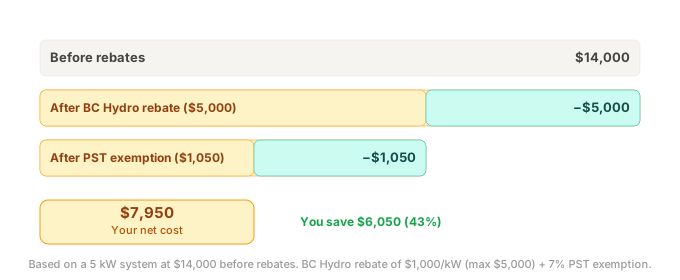
- Available incentives: BC Hydro rebate (up to $5,000) + federal CGHAP (up to $5,000) + PST exemption (7%)
- Annual savings: $800–1,400 depending on system size, utility, and self-consumption
- Payback period: 10–15 years, with 15–20 additional years of free electricity
- Net metering change: BC Hydro moves to 10¢/kWh export rate (July 2026); FortisBC keeps 1:1 retail credits
Use our solar calculator to see what these numbers look like for your specific home.
Solar Energy Potential by BC Region
How much electricity a solar system produces across British ColumbiaBC's solar potential varies significantly by region. The Interior and Okanagan receive the most sun, while coastal cities get less direct sunlight but still produce meaningful solar energy year-round. Even Vancouver - often assumed to be too cloudy for solar - produces roughly 1,000 kWh per kilowatt of installed capacity annually.
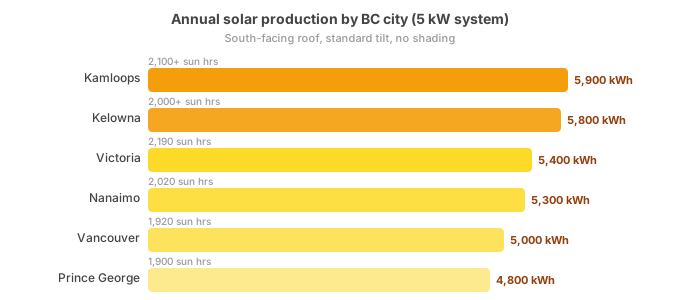
Annual Solar Production by City
The table below shows estimated annual energy production for common residential system sizes across six BC cities. Production figures are based on south-facing roof installations with standard tilt angles.
| City | Sun Hours/Year | 5 kW System | 10 kW System | 15 kW System |
|---|---|---|---|---|
| Kelowna | 2,000+ | 5,800 kWh | 11,600 kWh | 17,400 kWh |
| Kamloops | 2,100+ | 5,900 kWh | 11,800 kWh | 17,700 kWh |
| Victoria | 2,190 | 5,400 kWh | 10,800 kWh | 16,200 kWh |
| Nanaimo | 2,020 | 5,300 kWh | 10,600 kWh | 15,900 kWh |
| Vancouver | 1,920 | 5,000 kWh | 10,000 kWh | 15,000 kWh |
| Prince George | 1,900 | 4,800 kWh | 9,600 kWh | 14,400 kWh |
Estimates based on south-facing installations, standard tilt, no shading. Actual production varies with roof orientation, tilt angle, shading, and equipment efficiency. Source: Natural Resources Canada PV potential data and Energy Hub.
Monthly Production Profile
Solar production in BC follows a strong seasonal pattern. A typical 5 kW system in the Lower Mainland produces roughly this monthly profile:
| Month | kWh (5 kW system) | % of Annual |
|---|---|---|
| January | 200 | 4% |
| February | 290 | 6% |
| March | 420 | 8% |
| April | 500 | 10% |
| May | 520 | 10% |
| June | 550 | 11% |
| July | 600 | 12% |
| August | 590 | 12% |
| September | 470 | 9% |
| October | 370 | 7% |
| November | 220 | 4% |
| December | 185 | 4% |
| Annual Total | 4,915 | 100% |
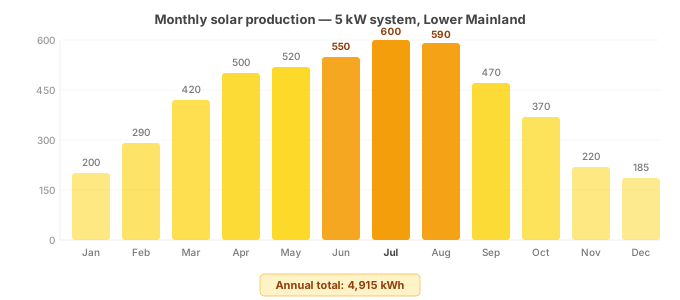
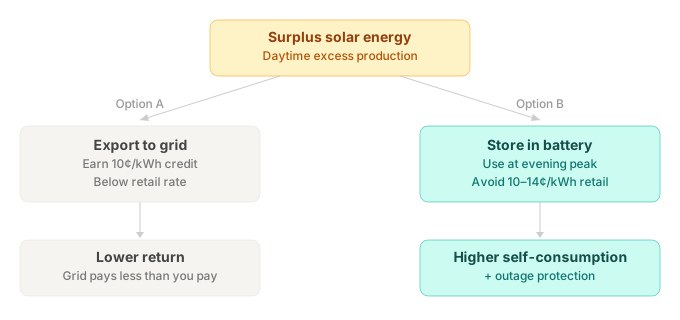
May through September accounts for roughly 55% of annual production. This seasonal pattern is why net metering is so important in BC - you bank summer surplus to offset winter consumption. For homeowners with battery storage, the shoulder months (March-April, September-October) are where batteries add the most value by capturing daytime surplus that would otherwise be exported at 10c/kWh.
What This Means for System Sizing
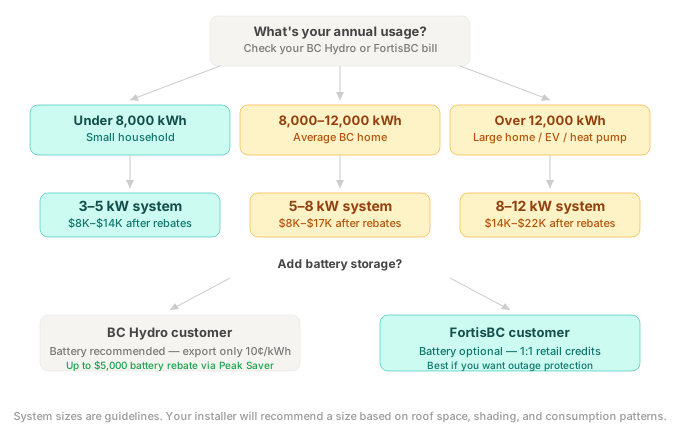
A typical BC household consumes 10,000-11,000 kWh per year. A 5 kW system in Vancouver covers roughly 50% of that; a 10 kW system covers nearly all of it. In Kelowna or Kamloops, the higher solar irradiance means a 5 kW system covers closer to 55-60% of household consumption. If you are on BC Hydro's new 10c/kWh export rate, sizing to match your consumption (rather than oversizing for maximum export) gives you the best return.
Current British Columbia Solar Incentives (2026)
Programs that save you money on solar| Program | Amount | Eligibility |
|---|---|---|
| Canada Greener Homes Affordability Program | No-cost retrofits | Low-to-median income |
| BC Hydro Self-Generation Rate | 10¢/kWh export | New customers (July 2026) |
| BC Hydro Solar & Battery Rebate | Up to $10,000 | BC Hydro residential |
| FortisBC Net Metering | 1:1 retail credit | FortisBC electricity customers |
| CleanBC Better Homes Rebate | Up to $5,500 | Heat pumps, insulation, windows (not solar-specific) |
| No PST on Solar Equipment | 0% PST | All installations |
Municipal Solar Incentives in BC
City-level programs that stack on top of provincial and federal incentivesBeyond provincial and federal programs, several BC municipalities offer their own solar incentives. These can be stacked with BC Hydro rebates and the PST exemption for additional savings.
City of New Westminster - Solar & Battery Rebate Program
New Westminster operates its own municipal electrical utility and runs a dedicated solar and battery rebate program in collaboration with BC Hydro. The rebate structure mirrors BC Hydro's program: up to $5,000 for solar panels ($1,000/kW, capped at 50% of cost) and up to $5,000 for battery storage ($500/kWh, capped at 50% of cost). New Westminster residents apply through the city rather than BC Hydro directly. Because New Westminster has its own utility, residents are not BC Hydro customers - but the city has partnered to offer equivalent incentives.
Municipal Financing (PACE-Style Programs)
Some BC municipalities are exploring property-assessed clean energy (PACE) financing, which would allow homeowners to finance energy upgrades through their property tax bill. BC's Community Charter permits local improvement charges that could enable this model. As of April 2026, no BC municipality operates a confirmed, active PACE-style solar financing program comparable to Alberta's Clean Energy Improvement Program. Check with your municipality for current financing options — Vancouver, in particular, has explored clean energy financing through its Renewable City Action Plan but does not currently offer a dedicated solar loan program.
City of Kamloops - See the Heat Program
Kamloops offers the See the Heat Program, which provides free thermal camera rentals so homeowners can identify heat loss and energy inefficiencies before investing in upgrades. While not a direct solar rebate, it helps homeowners optimize their overall energy profile before sizing a solar system - ensuring you invest in insulation and air sealing first, then right-size your solar array to your actual needs. Kamloops also offers general rebates and incentives for residential energy improvements.
Other Municipal Programs
Several other BC municipalities offer energy-related incentives that can complement a solar installation. The District of Saanich, City of Victoria, City of Kelowna, and others have various sustainability programs including home energy assessments, heat pump rebates, and building retrofit incentives. While not all are solar-specific, they contribute to overall energy efficiency and can improve the ROI of a solar system by reducing your baseline consumption first. Check your local municipality's website or contact your installer to identify any programs available in your area.
Net Metering in British Columbia
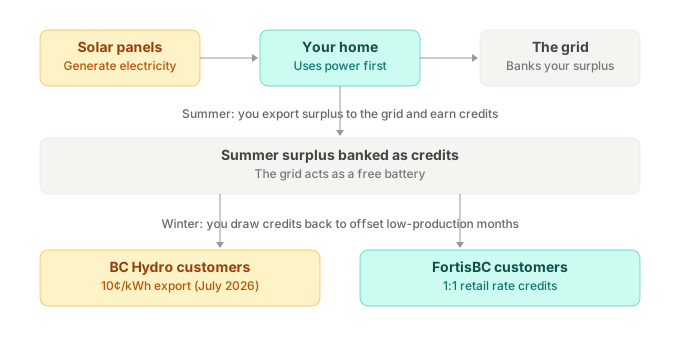
How you get paid for surplus solar electricityNet metering is the mechanism that makes residential solar financially viable in BC. When your panels generate more electricity than your home is using, the surplus flows to the grid and you receive credits on your bill. In effect, the grid acts as a free battery - you bank energy during long summer days and draw it back in winter.
British Columbia has two electric utilities with separate net metering programs, and the rules are changing in 2026.
BC Hydro: The Shift to Self-Generation Rates
BC Hydro serves roughly 95% of the province’s electricity customers. Until July 2026, its net metering program offered a straightforward 1:1 credit - every kilowatt-hour you exported was worth the same as a kilowatt-hour you consumed. That’s changing.
Effective July 1, 2026, the BCUC has approved a new Self-Generation Service Rate (Rate Schedule 2289) that replaces the old net metering rate for new customers and existing customers who received a BC Hydro solar rebate. Under the new rate, surplus electricity is compensated at a flat 10¢/kWh - below BC Hydro’s current retail rates of 10.73¢/kWh (Tier 1) and 13.62¢/kWh (Tier 2).
The key implications for homeowners:
- New customers (after July 1, 2026) go directly onto the 10¢/kWh export rate.
- Existing customers who took a BC Hydro rebate transition to the new rate on July 1, 2026.
- Existing customers without a rebate are grandfathered on the old 1:1 rate for up to 20 years.
- The generation size cap has been removed and replaced with a 100 kW per phase export limit.
- A new Community Generation Service Rate allows shared solar projects (strata buildings, community solar co-ops) to sell up to 2 MW at 10¢/kWh.
The practical takeaway: self-consumption is now more valuable than grid export. Homeowners should size their systems to match household usage and consider battery storage to capture surplus energy rather than selling it at 10¢/kWh. For a full breakdown of the rate change, see our BC Hydro net metering changes guide.
Run your numbers through our solar calculator to see how the new rate structure affects your specific savings based on your roof, usage, and utility territory.
FortisBC: Traditional Net Metering Continues
FortisBC’s net metering program operates independently and serves customers primarily in the Southern Interior, Okanagan, and Kootenay regions. Unlike BC Hydro’s new rate, FortisBC still offers standard retail-rate credits for surplus generation.
FortisBC’s program uses a Kilowatt Hour Bank: excess generation in any billing period is banked and applied to future bills. Any credits remaining after 12 months are settled at the same retail rate. Systems must use a renewable energy source (solar, wind, geothermal, or biomass), be located on your property, and have a maximum generating capacity of 50 kW. Interconnection is free - unlike some Atlantic provinces where connection fees can exceed $500.
If you’re a FortisBC electricity customer, net metering remains straightforward and favourable. Check your utility bill to confirm which utility serves your home before planning your system.
Which rate applies to you?
Get a quote from BC installers who can model your savings under the new rules.
BC Hydro Solar & Battery Rebates
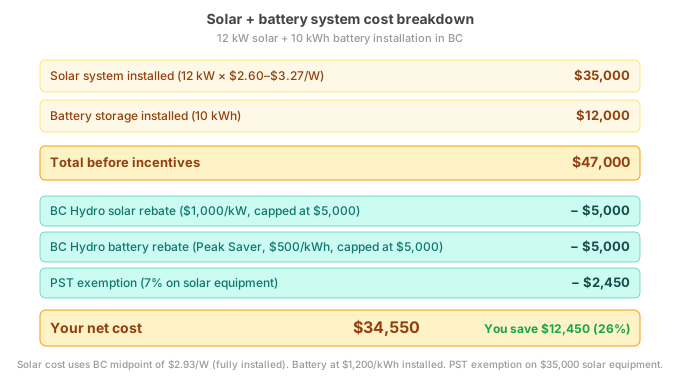
Up to $10,000 toward your solar-plus-battery systemBC Hydro’s rebate program is one of the most generous utility-level solar incentives in Canada. It offers up to $5,000 for solar panels and up to an additional $5,000 for battery storage - a combined $10,000 that can offset 25–35% of a typical residential system’s cost.
Solar Panel Rebate
The solar rebate is calculated at $1,000 per kilowatt (kW) of installed generator capacity, capped at 50% of total project cost (including labour and materials). Maximum rebate: $5,000. A typical 5 kW system would qualify for the full $5,000 as long as total project cost exceeds $10,000.
Battery Storage Rebate
Battery rebates are calculated at $500 per kilowatt-hour (kWh) of installed storage capacity, also capped at 50% of total cost. As of April 1, 2026, the maximum rebate depends on whether you enrol in BC Hydro’s Peak Saver program:
- With Peak Saver enrolment: up to $5,000 (with or without solar)
- With solar but without Peak Saver: up to $1,500
- Battery-only without Peak Saver: no longer eligible
Peak Saver lets BC Hydro occasionally draw on your battery during peak grid demand periods in exchange for the higher rebate. You must enrol within 14 days of interconnection approval.
Important Requirements
Beginning June 1, 2026, all installations must be completed by a Home Performance Contractor Network (HPCN) member to qualify for rebates. You must receive application pre-approval from BC Hydro before purchasing equipment. Tesla products are currently not eligible. The property must be in BC Hydro’s service territory with a residential account. Full eligibility details and the application form are on BC Hydro’s solar and battery rebate page.
Financing Solar in British Columbia
How to pay for your system without a large upfront cost$11,000–$14,000 - that's what a typical 5 kW system costs after rebates, and it's still the biggest barrier for most BC homeowners. The good news: several financing options can spread that cost over time while you start saving from day one.
Municipal Financing Options
Some BC municipalities are exploring or piloting property-assessed clean energy (PACE) financing, which allows homeowners to finance energy upgrades through their property tax bill. BC's Community Charter permits local improvement charges that could enable this model. As of April 2026, no BC municipality operates a confirmed, active PACE-style solar financing program comparable to Alberta's Clean Energy Improvement Program. Check with your municipality for current financing options.
Home Equity Line of Credit (HELOC)
A HELOC lets you borrow against your home’s equity at relatively low interest rates (typically prime + 0.5% to 1%). Since solar panels increase your property value, you’re effectively investing equity into an asset that generates returns through reduced electricity bills. Many BC homeowners find that monthly loan payments are offset by monthly energy savings, making the system cash-flow neutral or positive from the start.
Dealer and Installer Financing
Some BC solar installers offer in-house financing or partnerships with lenders that provide 0% interest promotional periods or fixed monthly payment plans over 5–15 years. When comparing quotes, ask each installer about financing options. Factor in the total cost of financing (interest paid over the loan term) alongside the system price.
PACE Financing
Property Assessed Clean Energy (PACE) programs allow energy upgrades to be financed through your property tax assessment. Several BC municipalities are exploring or operating PACE-style programs. Check with your municipality for availability.
The math: A $13,000 system (after rebates) financed over 10 years at 4% costs about $132/month. If your solar savings are $100/month, you’re paying only $32/month out of pocket for the first 10 years - then enjoying free electricity for the remaining 15+ years of the system’s life.
British Columbia Solar Costs & Savings
What you'll pay and what you'll save after all available BC incentivesSolar costs in BC have dropped significantly over the past decade while incentive programs have expanded. The table below shows estimated costs and savings for three common residential system sizes, factoring in BC Hydro rebates and the federal Canada Greener Homes Affordability Program.
| System Size | Cost Before Rebates | BC Hydro Rebate | Federal (CGHAP) | Net Cost | Annual Savings | Payback Period |
|---|---|---|---|---|---|---|
| 5 kW | $13,000–15,000 | $5,000 | $5,000 | $3,000–5,000 | $600–900 | 4–7 years |
| 8 kW | $19,000–22,000 | $5,000 | $5,000 | $9,000–12,000 | $900–1,200 | 8–12 years |
| 10 kW | $23,000–27,000 | $5,000 | $5,000 | $13,000–17,000 | $1,100–1,400 | 10–15 years |
Costs reflect BC averages as of April 2026. BC Hydro rebate is $1,000/kW up to $5,000 maximum. CGHAP provides up to $5,000 for eligible solar installations. Actual savings depend on electricity consumption, rate structure, and self-consumption ratio.
These figures reflect provincial averages. Your actual costs and savings depend on your roof orientation, shading, electricity usage, and utility territory. Use our solar calculator to estimate savings for your specific situation.
The Solar Installation Process in BC
What to expect from first call to flipping the switchInstalling solar in British Columbia follows a regulated process that involves your installer, your municipality, and your utility (BC Hydro or FortisBC). Here is a step-by-step walkthrough of what to expect.
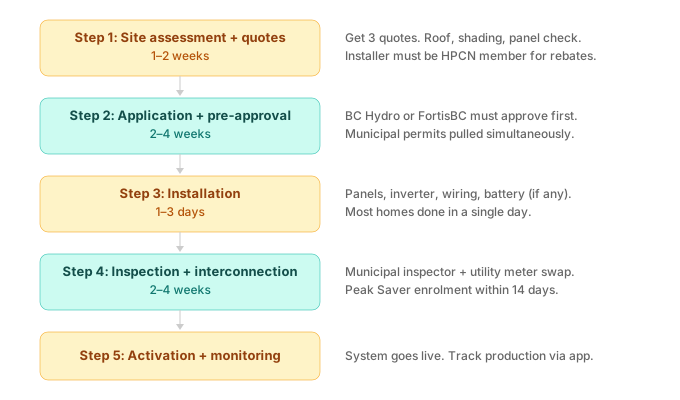
Step 1: Site Assessment and Quotes (1-2 weeks)
A qualified installer visits your property to evaluate your roof orientation, shading, structural condition, and electrical panel. They review your last 12 months of electricity bills to size the system to your consumption. You should get at least three quotes from different installers. Each quote should include system size, equipment specifications, total cost, estimated annual production, and projected savings. As of June 2026, your installer must be a BC Hydro Home Performance Contractor Network (HPCN) member if you want to qualify for rebates.
Step 2: Application and Pre-Approval (2-4 weeks)
Before purchasing any equipment, your installer submits a self-generation application to BC Hydro (or FortisBC, or New Westminster Electrical Utility depending on your location). This step is mandatory if you want rebates - BC Hydro must pre-approve your system before installation begins. Your installer also pulls the necessary municipal building and electrical permits. Permit requirements vary by municipality, but most BC jurisdictions require both.
Step 3: Installation (1-3 days)
Once pre-approved, your installer mounts the racking system on your roof, attaches the solar panels, runs wiring, installs the inverter (and battery if applicable), and connects everything to your electrical panel. Most residential installations take 1-3 days for the physical work. Complex roofs, multiple arrays, or battery systems may take slightly longer.
Step 4: Inspection and Interconnection (2-4 weeks)
After installation, a municipal electrical inspector verifies that the system meets safety and electrical codes. Your installer then submits final documentation to BC Hydro or FortisBC for interconnection approval. The utility reviews the paperwork, installs or reconfigures your meter for bidirectional measurement, and grants permission to operate. This step typically takes 2-4 weeks. If you applied for BC Hydro's battery rebate through Peak Saver, you must enrol within 14 days of interconnection approval.
Step 5: Activation and Monitoring
Once interconnection is approved, your system goes live. Your inverter begins converting solar energy into usable electricity, surplus flows to the grid, and credits start accumulating on your bill. Most modern inverters include monitoring apps that let you track production, consumption, and grid export in real time. Maintenance is minimal - an annual inspection and occasional panel cleaning (to remove debris or snow buildup) is typically all that's needed. Your panels are warrantied for 25 years; inverters typically carry a 10-15 year warranty.
Total timeline: From first quote to flipping the switch, expect 6-10 weeks in most BC municipalities. Working with experienced HPCN-member installers who know the local permitting process can shave weeks off this timeline.
Choosing Solar Equipment for BC
Panels, inverters, and batteries suited to British Columbia conditionsSolar Panel Types
Monocrystalline panels are the top choice for BC installations. Their higher efficiency (20-22%) means they generate more electricity per square foot - an important advantage on overcast days common in coastal BC. While polycrystalline panels cost less upfront, their lower efficiency (15-17%) makes them a poor fit for BC's diffuse-light conditions. For homes with partial shading from trees or nearby buildings, look for panels with half-cut cell technology, which maintains output even when part of the panel is shaded.
Most BC installers carry Canadian Solar, Longi, REC, and Silfab panels. Silfab manufactures in Ontario, which appeals to homeowners who prefer Canadian-made equipment. Panel warranties typically run 25-30 years for output and 12-15 years for product defects.
Inverter Options
String inverters connect all your panels in a series and convert the combined DC output to AC power. They work well for unshaded roofs with consistent panel orientation. Microinverters attach to each individual panel, allowing them to operate independently - if one panel is shaded or dirty, the rest keep producing at full capacity. For BC homes with complex rooflines or partial shading, microinverters from Enphase are the most popular choice. Hybrid inverters combine solar conversion with battery management in a single unit, reducing installation complexity and cost if you plan to add storage.
Battery Storage
Which battery chemistry holds up best in a BC winter? Lithium iron phosphate (LFP). These batteries handle our temperature swings better and last longer (10-15 years, 5,000+ cycles) than nickel manganese cobalt (NMC) alternatives, though they cost roughly 10-15% more upfront. If you're enrolling in BC Hydro's Peak Saver program to access the full $5,000 battery rebate, confirm your chosen battery is on BC Hydro's approved equipment list - Tesla products are not currently eligible. Popular eligible options include the Enphase IQ Battery, Franklin Home Power, and sonnenCore. A typical 10 kWh battery adds $10,000-$15,000 before rebates and provides 8-12 hours of backup for essential loads during outages.
Not sure if a battery makes financial sense for your situation? Our calculator can model solar-only vs. solar-plus-battery scenarios for your address.
Not sure which system fits your home?
A qualified BC installer can assess your roof, recommend equipment, and show you exactly what a system would produce at your address.
Common Myths About Solar in BC
Separating fact from fiction about solar power in British Columbia"It rains too much in BC for solar to work"
BC's lower mainland receives more annual solar radiation than Germany, the world's former solar leader. Solar panels produce electricity from light, not direct sunshine, and modern panels convert diffuse light efficiently. A 5 kW system in Vancouver generates roughly 4,800-5,200 kWh annually - enough to offset 60-80% of a typical household's consumption. Kelowna and Kamloops receive even more sun, producing 5,400-6,000+ kWh from the same system.
"BC's electricity rates are too low for solar to make sense"
While BC Hydro's rates are lower than Ontario or Nova Scotia, they've increased steadily - about 3-5% annually over the past decade. At current Step 1 and Step 2 rates, a solar system that costs $11,000-$14,000 after rebates pays for itself in 10-15 years and then provides free electricity for another 15-20 years. For FortisBC customers paying higher rates, the payback can be even faster. The financial case strengthens further when you factor in rising rates over the system's 25-30 year lifespan.
"The net metering change killed solar in BC"
BC Hydro's shift from 1:1 retail-rate credits to the 10¢/kWh Self-Generation Rate (RS 2289) starting July 2026 does reduce the value of exported electricity. However, solar still makes strong financial sense because most well-sized systems are designed so you consume the majority of your production directly, avoiding retail rates of 10-15¢/kWh. Pairing solar with a battery further increases self-consumption. FortisBC customers are unaffected entirely - their traditional 1:1 net metering program continues unchanged.
"Solar panels damage your roof"
Professional installations actually protect the portion of roof beneath the panels from weather exposure. Installers use engineered mounting systems with flashed attachment points that maintain your roof's waterproof integrity. In BC, any reputable installer will assess your roof condition before installation and recommend repairs if needed. Most panel mounting systems are compatible with asphalt shingle, metal, and flat (TPO/EPDM) roofs common in BC homes.
"Solar panels require constant maintenance"
Solar panels have no moving parts and require very little upkeep. BC's regular rainfall handles most cleaning naturally. An annual visual inspection and occasional rinse with a garden hose is typically all that's needed. Inverters may need replacement once during the system's lifetime (after 10-15 years for string inverters; microinverters are warrantied for 25 years). Snow generally slides off panels due to their angle and dark surface, though a soft brush can help after heavy snowfalls in Interior BC.
Top-Rated British Columbia Solar Installers
Verified BC solar companies with real reviews
Empower Energy
📍 Vancouver, BC Residential-Commercial
Shift Energy Group
📍 Victoria, BC Residential-EV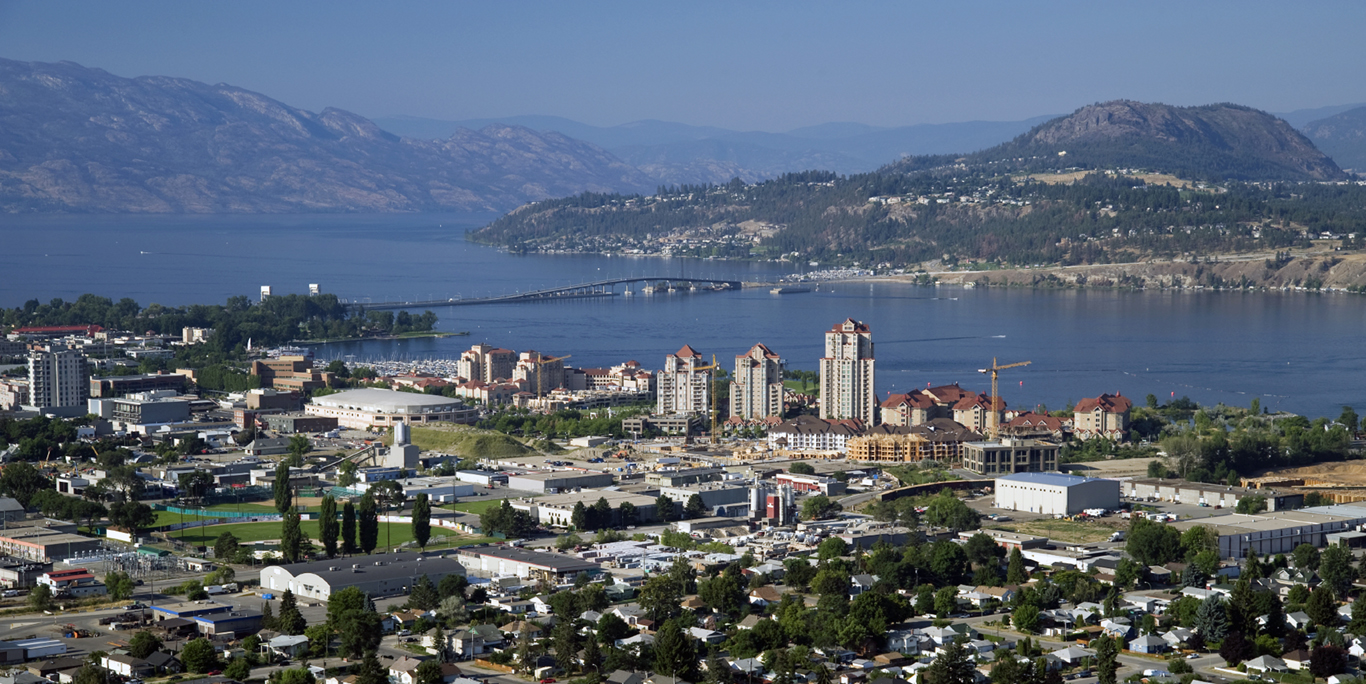
Downtown Electric
📍 Kelowna, BC Residential-Commercial-EVThese are three of BC's top-rated solar companies. Browse all BC installers in our full installer directory to compare quotes, read reviews, and find the right fit for your project.
Ready to go solar?
You've done the research. Take the next step with free quotes from certified BC installers.
Get your free quotes Compare prices, equipment, and warranties.British Columbia Solar FAQ
Answers to the most common questions from BC homeownersHow does BC Hydro net metering work in 2026?
BC Hydro’s net metering program is transitioning. Existing customers without a BC Hydro rebate remain on the legacy 1:1 retail-rate credit under their grandfathered terms. New customers and those who received a BC Hydro solar rebate move to the Self-Generation Service Rate (Rate Schedule 2289) on July 1, 2026, which pays a flat 10¢/kWh for exported surplus. The generation size cap has been removed and replaced by a 100 kW per phase export limit.
What’s the difference between BC Hydro and FortisBC for solar?
BC Hydro serves most of the province and is transitioning to a 10¢/kWh export rate in July 2026. FortisBC serves the Southern Interior, Okanagan, and Kootenay regions and still offers traditional 1:1 retail-rate net metering credits with a Kilowatt Hour Bank. Your utility determines which net metering program applies - check your electricity bill to confirm which utility serves your home.
Do solar panels work well in BC’s rainy climate?
Yes - BC gets more sunshine than most people assume, especially in the Interior and southern regions. Even in Vancouver, a 5 kW system produces roughly 5,000 kWh per year. Modern panels perform well in overcast conditions because they capture diffused light, and BC’s mild temperatures actually help panels operate more efficiently than in extreme heat. Solar is well-proven across all BC regions.
Is solar worth it in Vancouver specifically?
Vancouver receives about 1,900 hours of sunshine annually and a 5 kW system can produce roughly 5,000 kWh/year - enough to offset 50–70% of a typical household’s consumption. After BC Hydro rebates and the PST exemption, a 5 kW system costs around $11,000–$13,000 with a payback period of 10–14 years. With 25+ year panel lifespans, that’s over a decade of free electricity after payback.
What rebates can I stack in BC?
BC homeowners can stack several programs. The Canada Greener Homes Affordability Program may cover no-cost retrofits for qualifying households. The CleanBC Better Homes Rebate offers up to $5,500 for income-qualified homeowners. BC’s PST exemption saves 7% on all solar equipment. BC Hydro offers up to $5,000 for solar panels and up to $5,000 for battery storage. Combined, these incentives can reduce total system cost by 30–50%.
Do I need a battery with solar in BC?
A battery isn’t required, but it’s becoming a smarter investment under the new rate structure. Without one, your surplus solar goes to the grid at 10¢/kWh. With a battery, you store that energy and choose when to use it — powering your home in the evening, riding through sudden outages, or shifting consumption away from peak hours as BC Hydro moves toward time-of-use billing. BC Hydro offers up to $5,000 in battery rebates through the Peak Saver program. If outage protection, energy independence, or control over when you use power matters to you, a battery is worth discussing with your installer.
How long does a solar installation take in BC?
The physical installation takes 1–3 days. However, the full process - including site assessment, permits, BC Hydro or FortisBC interconnection approval, and inspections - usually takes 6–10 weeks from signing a contract to activation. You must receive BC Hydro application pre-approval before purchasing equipment if you want to qualify for rebates. Working with experienced HPCN-member installers can streamline the timeline.
What happens to my solar panels if I sell my house?
Solar panels stay with the property and transfer to the new owner. Homes with solar typically sell faster and at a premium - studies show a 3–4% increase in property value. The BC Hydro net metering account transfers to the new homeowner, and any banked credits carry over. If you financed your system through a PACE-style municipal program, the remaining balance typically transfers with the property tax assessment.
Can I install solar on a strata or condo in BC?
It’s possible but more complex. Strata buildings require a ¾ vote from owners to approve common-property modifications. The new Community Generation Service Rate (launching July 2026) is a game-changer - it allows multiple customers to share a single solar facility and sell up to 2 MW back to BC Hydro at 10¢/kWh. This makes shared rooftop solar on strata buildings financially viable for the first time.
Is BC’s 7% PST exemption on solar equipment unique?
British Columbia specifically exempts solar equipment from its 7% PST. Alberta, Saskatchewan, and Manitoba have no PST, so solar equipment is untaxed there as well. In provinces with HST (Ontario, Nova Scotia, New Brunswick, etc.), the full harmonized rate applies to solar purchases.
Incentive amounts, program eligibility, and electricity rates referenced in this guide are current as of April 2026 and subject to change. Verify details with BC Hydro, FortisBC, or your provincial program administrator before making financial decisions.
Solar resources by province
Incentives, installers, and costs specific to your region


