
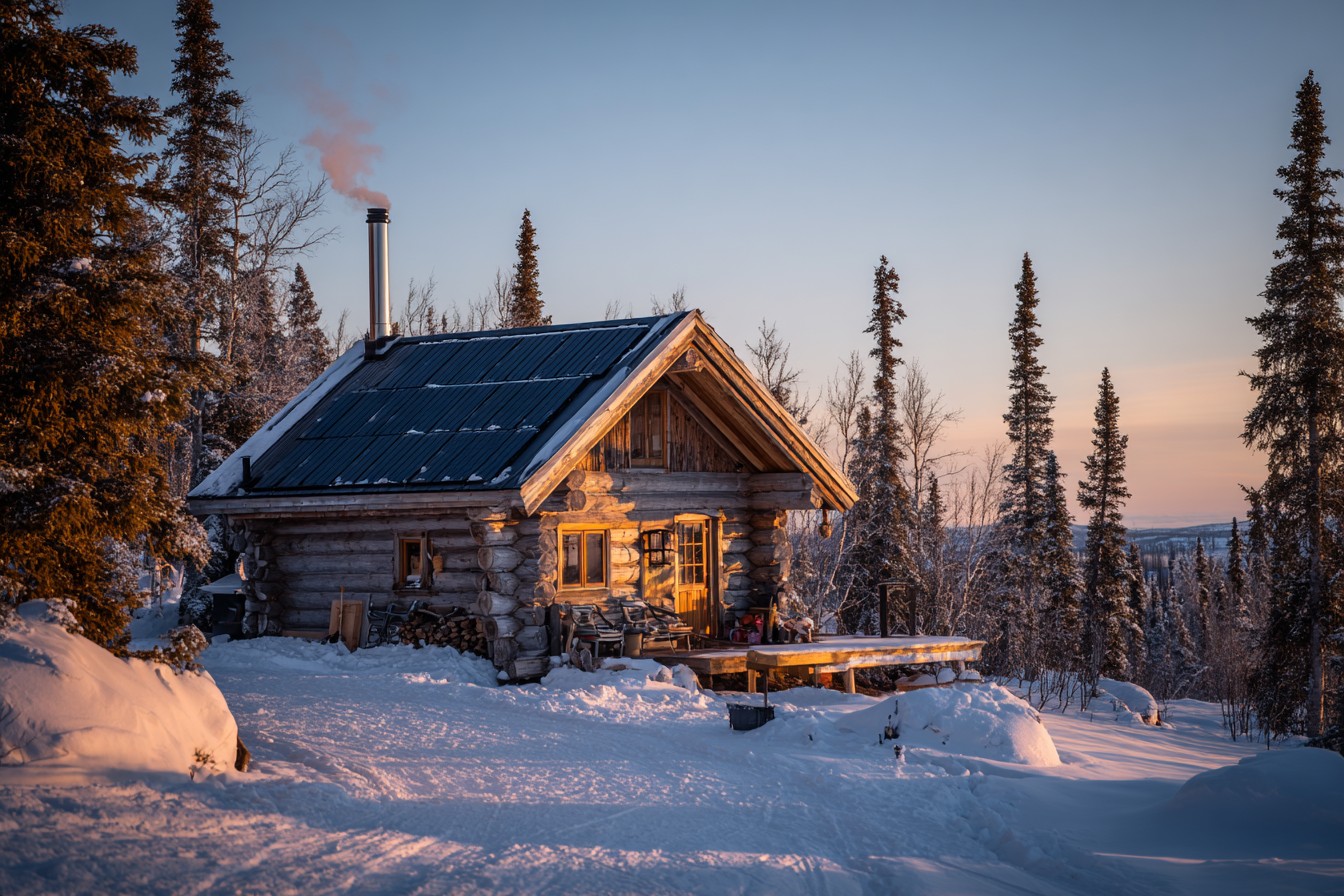
Success Story
Off-Grid and Thriving: How a Yukon Couple Powers Their Cabin Year-Round with Solar
With 20 hours of summer sun and a battery bank sized for winter, a Whitehorse couple hasn’t paid an electricity bill in three years — even through -40°C cold snaps.
This scenario is based on typical off-grid installation data for the Yukon as of 2026. Names and specific details are illustrative. All financial figures are calculated from Yukon Energy rate data, Yukon government rebate programs, and off-grid system pricing. Actual results vary based on system size, location, consumption habits, and battery configuration.
Zero electricity bills for three years. That’s the reality for a representative Yukon couple living in a 900 sq ft off-grid cabin outside Whitehorse. Their 6 kW solar array with 30 kWh of lithium battery storage powers lights, appliances, a well pump, internet, and a home office through every season — including the dark December weeks when the sun barely clears the horizon and temperatures drop to -40°C. Off-grid solar in the Yukon isn’t just possible; it’s the most practical power option when you’re 15 km from the nearest grid connection.
The Challenge: $50,000 to Connect to the Grid
The scenario: a couple in their 40s building a retirement cabin on rural land outside Whitehorse. The nearest Yukon Energy grid connection was 15 km away. The utility quoted approximately $50,000 for a grid extension — before monthly bills.
The alternative: a diesel generator at $400-$600/month ($48,000-$72,000 over 10 years).
Their concerns:
- Winter darkness. Whitehorse gets ~5.5 hours of daylight in December.
- Extreme cold. Would batteries survive -40°C?
- Reliability. Could they depend on solar for essentials?
Going Solar: The Installation
| Detail | Value |
|---|---|
| Location | Outside Whitehorse, Yukon |
| Home Type | 900 sq ft off-grid cabin |
| System Size | 6 kW (15 x 400W panels) |
| Panel Brand | Bifacial panels (snow albedo advantage) |
| Inverter | Off-grid hybrid inverter, 48V system |
| Battery | 30 kWh LFP lithium (heated enclosure) |
| Backup | Propane generator (emergency only) |
| Total Cost | $45,000 (before incentives) |
| Incentives | $5,000 Yukon off-grid rebate ($0.80/watt) |
| Net Cost | $40,000 |
| Monthly Bill | $0 |
| Grid Extension Quote | ~$50,000 |
| Generator Alternative | $400-$600/month ($48K-$72K/10 yrs) |
| Payback vs Generator | ~7 years |
| Install Timeline | 4 weeks (summer) |
Bifacial panels: Capture reflected light from snow. CBC reported 10-20% winter production boost.
30 kWh LFP battery in heated enclosure: Insulated with thermostat keeping bank above 5C. Heating draws ~2-3 kWh/day in coldest months.
Propane generator backup: Runs 15-25 days/year, ~$300-$400 in propane annually.
Yukon rebate: $0.80/watt up to $5,000.
Key Takeaway
At $40,000 net vs $50,000 grid extension or $48K-$72K in generator costs, off-grid solar was the cheapest long-term option.
The Numbers: A Full Year of Production
| Month | Solar Production | Generator Use | Notes |
|---|---|---|---|
| January | 80 kWh | 8 days | Shortest days, -25 to -40°C |
| February | 180 kWh | 3 days | Days lengthening |
| March | 380 kWh | 0 days | Spring equinox |
| April | 520 kWh | 0 days | 15+ hours daylight |
| May | 680 kWh | 0 days | 18+ hours daylight |
| June | 750 kWh | 0 days | 20 hours daylight, peak |
| July | 720 kWh | 0 days | Long days |
| August | 580 kWh | 0 days | Still strong |
| September | 380 kWh | 0 days | Autumn equinox |
| October | 200 kWh | 0 days | Short days returning |
| November | 100 kWh | 5 days | Very short days |
| December | 50 kWh | 9 days | Darkest month |
| Annual | 4,620 kWh | ~25 days | Propane: ~$350/yr |
- June produces 15x more than December
- March-October: solar-only (8 months, zero generator)
- Annual generator cost ~$350 — less than one month of diesel
Life After Solar
Battery enclosure was critical. Without heated storage, LFP batteries fail in first winter. Adds $2,000-$3,000 but essential below -20°C.
Summer surplus is wasted. Plans to add hot water diversion system.
Generator use dropped from 15 days in year one to 9 days by year three through load optimization.
Would they do it again? Yes — but with 8 kW instead of 6 kW.
Considering Off-Grid Solar?
Get a free assessment from installers experienced with northern installations. Get Your Free Solar Quote